


From the Field to the Dashboard – Built by Experts, for Experts.
Discover What's Really Happening in the Steel Industry
Use the AI-powered search engine to analyze production activity, market trends, and news faster than ever before.
Try the Free AI Search EngineSpain’s Steel Industry: Positive Trends Amid Strategic Developments and Plant Investments
The Spanish steel industry is witnessing a surge in positive activity, fueled by strategic initiatives and recent operational updates. Notably, the articles Tata Steel Nederland joins European circular steel research project and ArcelorMittal Spain head questions whether higher EU steel tariffs will be enough, Gijón blast furnace restarted highlight significant changes in plant activities, aligning with satellite data trends.
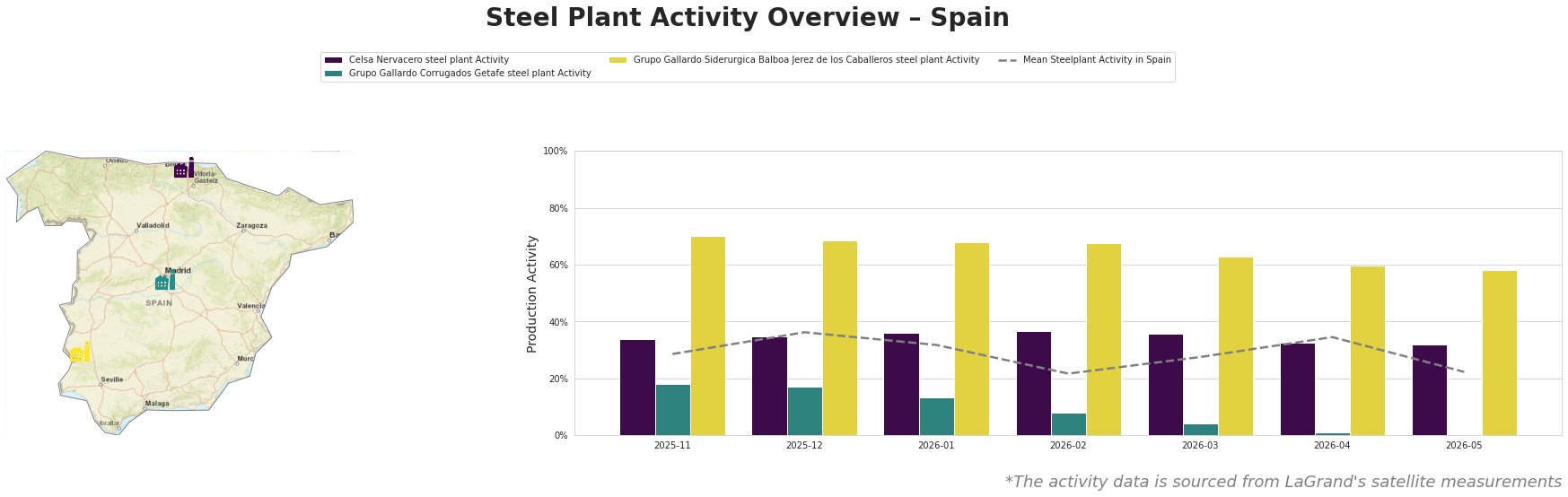
Celsa Nervacero’s activity peaked at 37% in February 2026 but dropped to 32% by May 2026. This reduced activity partially aligns with the market adjustments following the ArcelorMittal Spain head questions whether higher EU steel tariffs will be enough article, emphasizing the industry’s cautious outlook on EU tariffs. Additionally, Grupo Gallardo Siderurgica Balboa registered the highest activity level at 70% in November 2025, but has since seen a decline to 58% by May 2026, which could correlate with ongoing adjustments and expectations within the market.
Sidenor’s recent €13.6 million investment in their Basauri plant, as detailed in the article Spain’s Sidenor to invest €13.6 million to modernize Basauri steel plant, should bolster operational efficiency and production capabilities, aligning with a broader trend towards sustainability and potentially mitigating some supply risks in specialized steel markets.
In terms of market implications, buyers should anticipate reinforced domestic production capabilities stemming from Tata Steel’s circular initiative aimed at producing low-carbon steel from recycled scrap. Procurement strategies should focus on sourcing from Celsa Nervacero and Grupo Gallardo plants while remaining cognizant of potential supply fluctuations as these operational adjustments unfold.
Furthermore, while import tariffs may present challenges, as noted by ArcelorMittal Spain head questions whether higher EU steel tariffs will be enough, they could also provide protective barriers for domestic players, pushing buyers to prioritize local suppliers as European measures solidify post-implementation around July 2026.
In summary, steel buyers and market analysts should strategically position themselves to leverage local production strength while monitoring the impacts of regulatory changes and investment initiatives on market dynamics.