


From the Field to the Dashboard – Built by Experts, for Experts.
Discover What's Really Happening in the Steel Industry
Use the AI-powered search engine to analyze production activity, market trends, and news faster than ever before.
Try the Free AI Search EngineNeutral Steel Market Outlook for Asia: Activity Trends and Procurement Insights
Recent analyses in Asia’s steel market are shaped by shifting plant activity levels, particularly in India and wider implications from regional suppliers. The article “India’s IPL issues ammonia tender” highlights IPL’s move to secure essential raw materials amid domestic supply challenges. Although no direct connection can be drawn to activity levels, increased operational pressures on suppliers may influence steel production dynamics in the region.
Measured Activity Overview
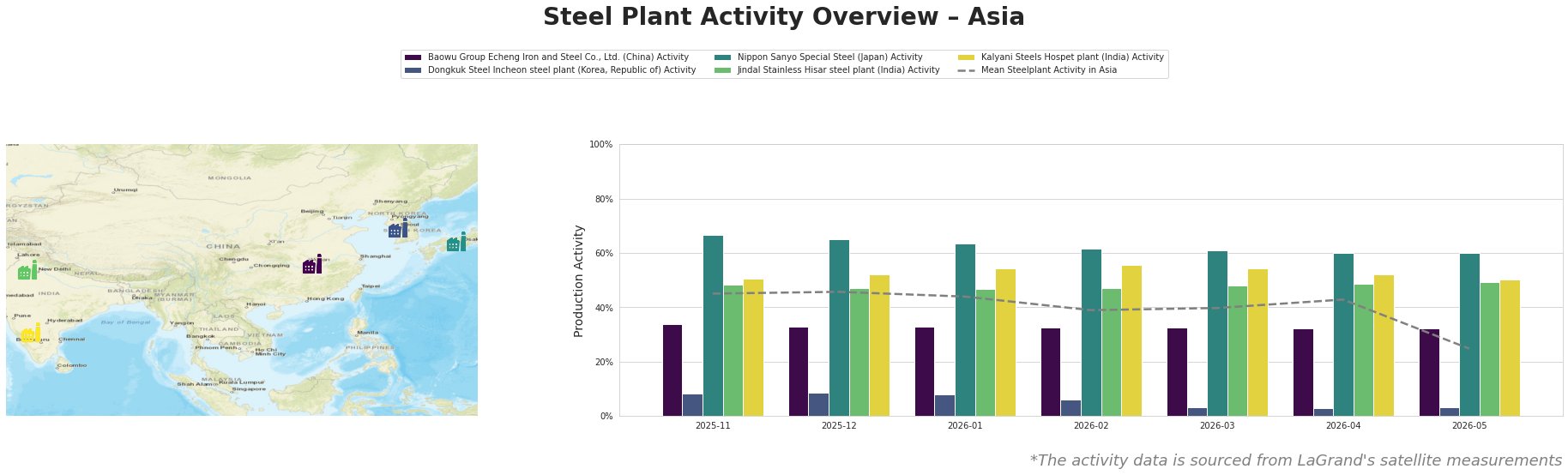
Activity levels have notably dropped across Asia, especially as the mean activity reached a low of 25% in May from 43% in April. Baowu maintains a consistent low of 32% but has not demonstrated significant volatility. Dongkuk Steel saw a decline to 3%, indicating operational stagnation, which may correlate with resource constraints discussed in “India’s IPL counterbids DAP at $930-935/t cfr: Update”, where demand analysis pressures local operations. Nippon Sanyo maintains steadiness with activity around 60%, highlighting resilience amidst regional market fluctuations.
Plant Insights
Baowu Group Echeng Iron and Steel Co., located in Hubei, has seen its activity stabilize at around 32%, well below mean levels. The ongoing challenges in raw material sourcing, as highlighted by IPL’s competitive tender approach, suggest that Baowu could experience potential supply chain impacts.
Dongkuk Steel Incheon Steel Plant is operating at merely 3%, reflecting a significant operational slowdown without any recent news linkage to supply chain adjustments. This drop necessitates immediate attention to maintenance and potential procurement shifts.
Nippon Sanyo Special Steel, while consistently engaged, operates at 60%. Its steadfast activity may benefit from stable demand in technology sectors, aligning with broader trends from India’s urgency in securing materials.
Jindal Stainless Hisar and Kalyani Steels show limited fluctuations around the 49-54% range, indicating operational consistency but lacking expansion under current market sentiments, resonating with “Indian April DAP stocks rise, remain lower than normal“ which hints at wider material pressures influencing procurement strategies.
Evaluated Market Implications
Potential supply disruptions are evident at Dongkuk Steel, which may need swift action to mitigate prolonged inactivity. Steel buyers and analysts should prioritize securing additional supply sources, especially from regions exhibiting stable operational metrics like Nippon Sanyo.
In the context of the evolving landscape shaped by India’s tender activity, firms may consider immediate procurement engagements to buffer against raw material shortages impacting local production capacities in Southeast Asia. Careful monitoring of IPL’s upcoming import decisions and shifts in DAP availability will be crucial for navigating the next few months in steel procurement.