


From the Field to the Dashboard – Built by Experts, for Experts.
Discover What's Really Happening in the Steel Industry
Use the AI-powered search engine to analyze production activity, market trends, and news faster than ever before.
Try the Free AI Search EngineAsian Steel Market Insights: Elevated Activity and Growing Export Dynamics
The Asian steel market is currently experiencing a positive trend, significantly influenced by developments in India and Turkey. Notably, “India’s NMDC raises iron ore prices in May” and “Steel exports from India rose by 24.9% y/y in April” indicate rising activity levels in iron ore production and steel export growth, correlating with observed increases in steel plant activity across the region.
Recent satellite data reveal a fluctuating but overall elevated steel production in Asia, with notable performance from key facilities.
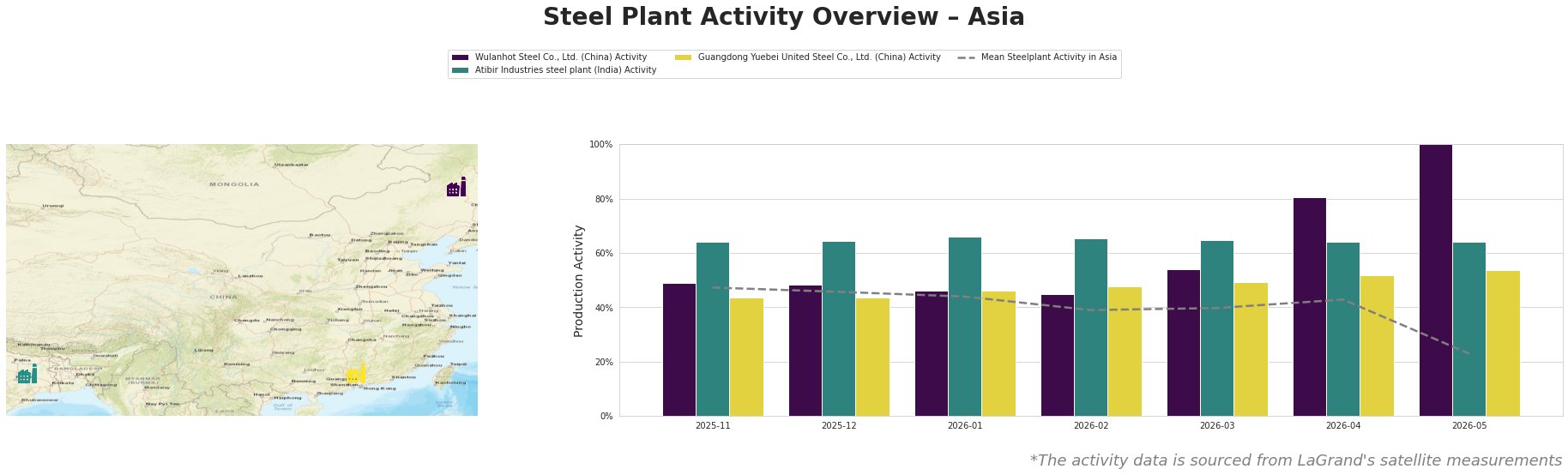
Wulanhot Steel Co., Ltd., located in Inner Mongolia, displayed a drastic increase in activity levels, peaking at 100% by May 2026—a rise attributed to global demands spurred by India’s enhance in iron ore prices. Its integrated production line focuses on finished rolled products, primarily serving the construction sector.
Atibir Industries in Jharkhand also maintained high output levels, peaking at 66% even amidst fluctuating domestic steel prices, correlating with “Steel exports from India rose by 24.9% y/y in April.” This robust output supports India’s rising consumption and export strategy, as the steel sector strives for 300 million tons capacity by 2030.
Guangdong Yuebei United Steel Co., Ltd. showed a steady performance, with activity resting at 54%, providing a stable supply of finished products such as rebar for infrastructure demands, although still below the peak performance of its counterparts.
The recent export uptick in India, revealed in “Steel exports from India rose by 24.9% y/y in April,” indicates rising global competitiveness. However, increased imports by 2.6 times year-on-year, as noted in “India increased iron ore imports in April by 2.6 times y/y,” signifies heightened competition.
Potential supply disruptions may arise as domestic production struggles to meet quality requirements fully; thus, the recommended procurement actions for steel buyers include:
-
Prioritize Contracts with Indian Manufacturers: Given the 24.9% increase in steel exports and anticipated further development in the domestic market punctuated by rising iron ore prices, maintaining steady supplier relationships in India can alleviate risks associated with competition.
-
Monitor Turkish Market Dynamics: Turkey’s increasing rebar exports, particularly to emerging markets, should be closely observed to assess supply alternatives and cost-effective procurement strategies.
These strategic insights are vital for steel buyers as they navigate the complexities of current market conditions influenced by significant geopolitical and economic factors.