


From the Field to the Dashboard – Built by Experts, for Experts.
Discover What's Really Happening in the Steel Industry
Use the AI-powered search engine to analyze production activity, market trends, and news faster than ever before.
Try the Free AI Search EngineSteel Market Stability in Asia: Activity Trends and Sulphur Price Surge Impact Analysis
The Asian steel market experiences a neutral sentiment, reflecting notable changes in production activities amid external pricing pressures. Recent reports indicate a price hike as “Abu Dhabi’s Adnoc raises May sulphur price by $160/t,” impacting cost structures, while no direct correlation was established with production activities from the satellite observations.
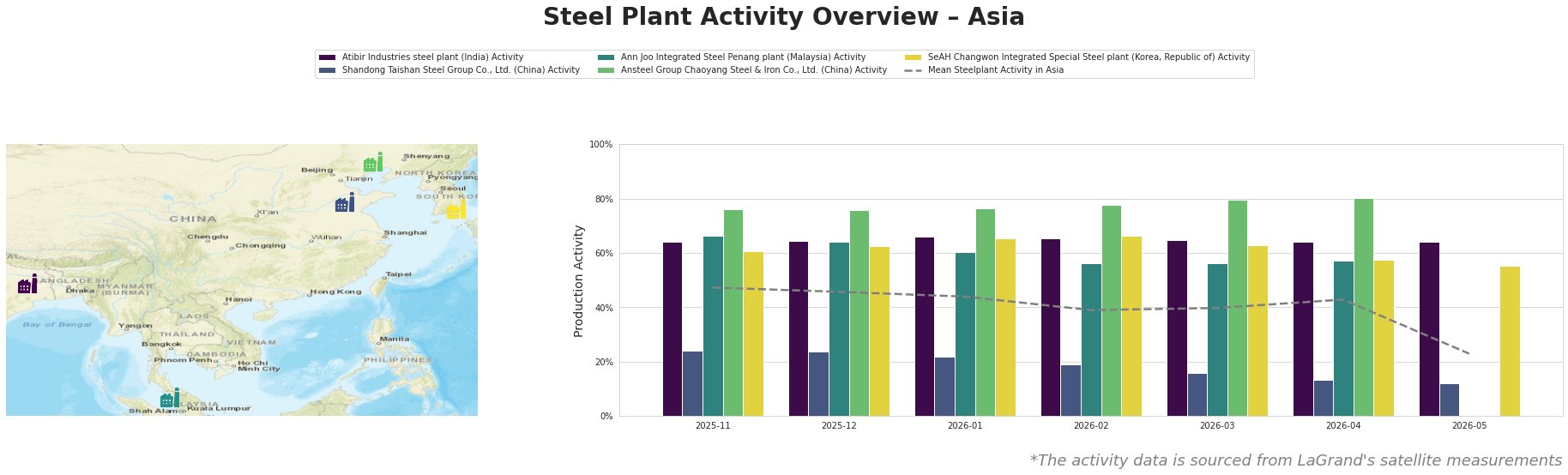
Activity levels across key plants, particularly Shandong Taishan Steel (12%) and Ansteel Group (55%), have shown significant downward trends, notably declining from previous months. Atibir Industries maintained stability at 64%, indicating resilience amid broader market challenges. However, Ann Joo Integrated Steel activity fluctuated minimally at 57%, showcasing a near stable trend.
Given the sulphur price increase outlined in the article “Abu Dhabi’s Adnoc raises May sulphur price by $160/t,” which adds to operational costs, potential supply disruptions should be factored in, especially for heavy users of sulphur in steel production. Caution is advised for procurement managers looking at upcoming contracts, particularly from plants heavily impacted by material costs.
To navigate this landscape effectively, steel buyers should consider locking in prices and securing supplies from Atibir Industries due to its higher activity stability. Despite more significant drops in productivity elsewhere, Shandong Taishan and Ann Joo Integrated may struggle to meet demands under imposed cost pressures.
In summary, the steel market remains cautiously neutral with specific monitoring recommended for procurement strategies, especially in light of the rising sulphur costs and observed production variability across critical suppliers.