


From the Field to the Dashboard – Built by Experts, for Experts.
Discover What's Really Happening in the Steel Industry
Use the AI-powered search engine to analyze production activity, market trends, and news faster than ever before.
Try the Free AI Search EngineNegative Steel Market Outlook for Asia: Supply Chain Risks Intensify Amid Geopolitical Tensions
Recent developments in Asia’s steel market indicate a deteriorating outlook due to escalating geopolitical tensions affecting the Strait of Hormuz, critically influencing energy supply and operational capacity at regional steel plants. The article “US, Iran to allow some Hormuz transit: Trump“ notes attempts to alleviate shipping disruptions, yet ongoing military threats underscore persistent risks. Additionally, fluctuations in crude oil prices, as reported in “Crude futures rise on reported US vessel attack: Update,” suggest volatile market conditions could translate into increased operational costs for steel manufacturers.
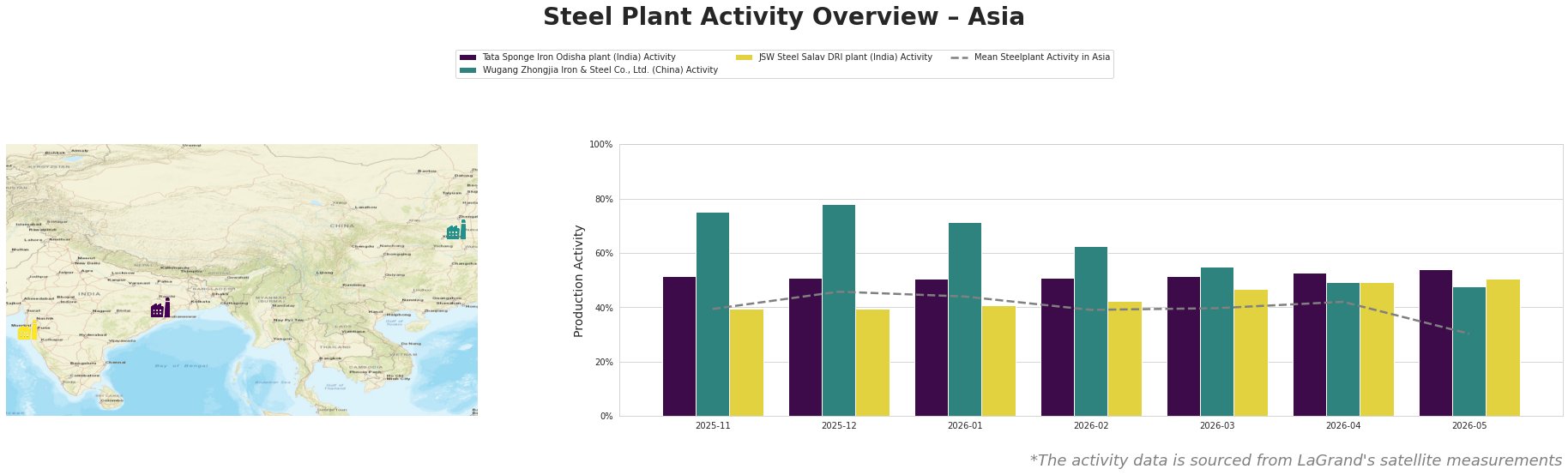
The activity levels across the observed steel plants portray a concerning trend with the mean plant activity dropping to 30.0% in May 2026, significantly lower compared to 39.0% just six months prior. The Wugang Zhongjia Iron & Steel Co., Ltd. demonstrated a notable decrease from 75.0% to 48.0%, reflecting a more significant decline compared to the mean, potentially linked to rising energy costs associated with crude fluctuations noted in “Crude futures surge 7pc to new four-year high.” The JSW Steel Salav DRI plant maintained a relatively stable activity level, yet still exhibits a decline from 41.0% to 51.0% in the last four months.
The Tata Sponge Iron Odisha plant also saw steady operations, easing from 51.0% in the previous months to 54.0% in May, suggesting resilience despite external pressures; however, this stability does not connect explicitly to recent news developments.
The geopolitical climate, highlighted in articles such as “Trump Hormuz order fails to drop shipping risk,” illustrates ongoing operational uncertainties, particularly in the supply chain, prompting steel buyers to consider proactive measures.
Supply disruptions seem imminent due to increased military activity in the region, reflected in reported incidents like those covered in “US, Iran exchange fire in Hormuz: Update.” The strategic advice for procurement managers includes diversifying sourcing routes away from traditional pathways and closely monitoring fuel price fluctuations which can impact overall production costs.
In light of these challenges, steel buyers are encouraged to secure contracts early and consider logistical adjustments to mitigate risks, particularly in regions dependent on crude imports subject to conflict-driven disruptions.