


From the Field to the Dashboard – Built by Experts, for Experts.
Discover What's Really Happening in the Steel Industry
Use the AI-powered search engine to analyze production activity, market trends, and news faster than ever before.
Try the Free AI Search EnginePositive Steel Market Outlook in Asia: India Surges Amidst China’s Production Decline
Recent data indicates a positive shift in Asia’s steel market, particularly driven by India’s significant production increase. According to the article, “Global steel production fell by 4.2% y/y in March,” China’s output witnessed a notable dip of 6.3%, reflecting a decline in domestic demand. Conversely, India experienced a robust 9.4% increase in production, underlining a diverging trend in regional steel activities. Satellite data corroborates these findings, showing stable activity levels at select steel plants, particularly in India, amidst China’s downturn.
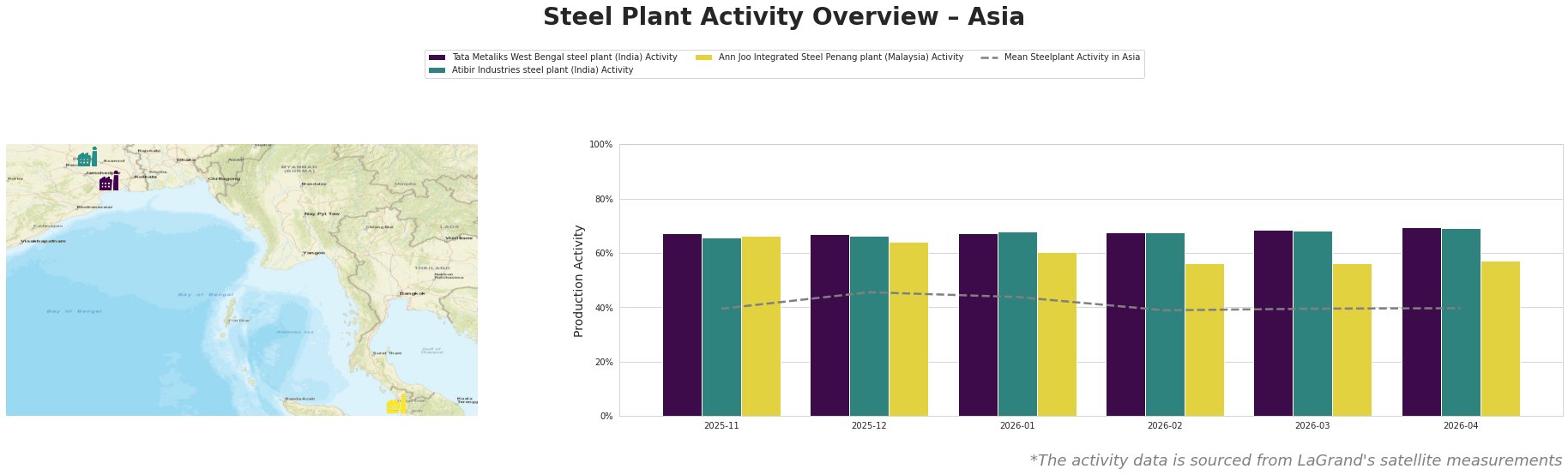
The activity levels at Tata Metaliks and Atibir Industries plants show notable stability with a slight upward trend, particularly for Tata, which reached 70% activity in April 2026. This stability contrasts with the declining trends reported in the broader Asian context, which experienced a mean activity of 40%.
Tata Metaliks, located in West Bengal, recorded a significant gain from 67.0% in December to 70.0% in April, showing resilience amidst declining trends in other regions. This aligns with India’s overall production increase highlighted in “Global steel production fell by 4.2% y/y in March,” which emphasizes the nation’s growing domestic demand.
Atibir Industries in Jharkhand maintained steady activity levels, peaking at 68.0% in March, although it slightly decreased to 69.0% in April. This stability may indicate a response to increased regional demand, though no direct connection to specific news articles could be established.
The Ann Joo Integrated Steel plant in Penang, Malaysia, exhibited fluctuations with a decrease from 60.0% in January to 56.0% in both March and April. This drop may suggest localized challenges that are not explicitly linked to the broader trends reported.
Evaluated Market Implications
The observed stability in India, particularly in Tata Metaliks, indicates that procurement strategies focusing on Indian steel suppliers could mitigate risks associated with China’s declining output and disrupted supply chains. As seen in “IREPAS: Global steel market steadies amid weaker growth,” the geopolitical tensions and fluctuating demand make it imperative for steel buyers to secure reliable suppliers while prioritizing those regions showing growth, such as India.
Buyers should prioritize contracts with Indian steel plants like Tata Metaliks and Atibir Industries due to their robust production capabilities and resilience. It’s essential to monitor the evolving situation in China, as any ongoing disruptions may further enhance India’s position as a steel supplier.