


From the Field to the Dashboard – Built by Experts, for Experts.
Discover What's Really Happening in the Steel Industry
Use the AI-powered search engine to analyze production activity, market trends, and news faster than ever before.
Try the Free AI Search EngineAsia Steel Market Outlook: Very Negative Trends Amidst Significant Supply Disruptions
Recent developments in the Asian steel market exhibit a very negative sentiment largely influenced by significant geopolitical events. Article “Attacks shut Saudi Satorp refinery units: TotalEnergies“ and “Riyadh discloses damage to key Aramco facilities“ indicate that damage to vital Saudi oil infrastructure, namely the East-West pipeline and the Manifa oil field, has resulted in increased production shutdowns in the region. This escalated activity has led to shutdowns across multiple facilities, including a 10% cut in TotalEnergies’ global output, directly impacting regional steel plants reliant on energy resources.
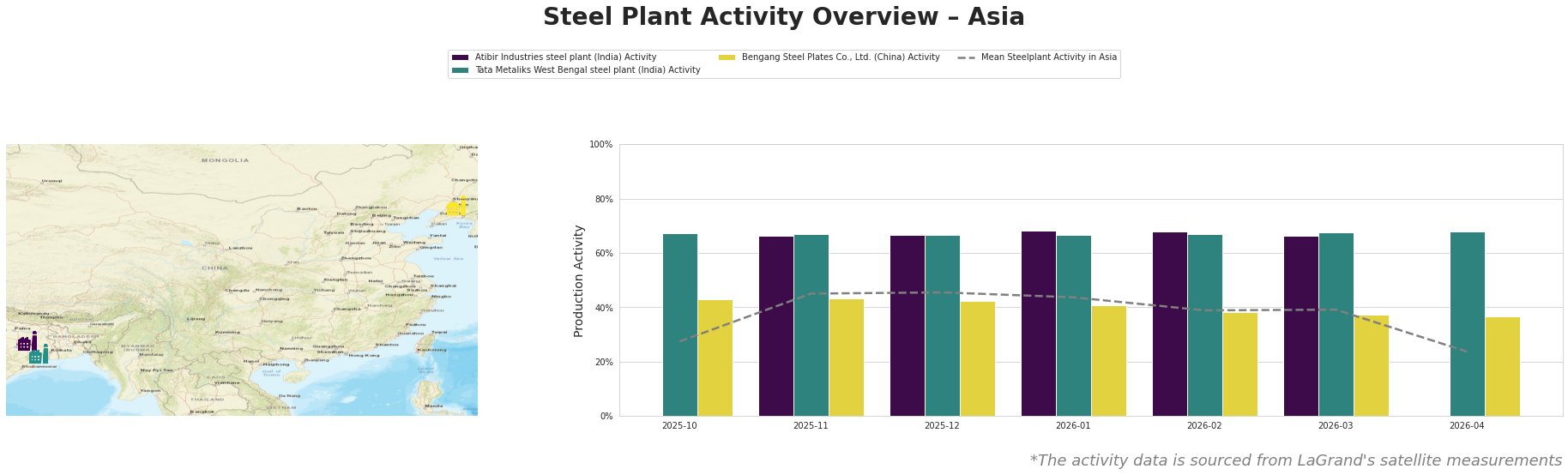
The aggregated data shows that the mean steel plant activity in Asia dropped significantly to 24.0% in April 2026, while the Atibir Industries steel plant was noted as inactive. Concurrently, Tata Metaliks maintained activity at 68.0%, demonstrating resilience amid regional instability, whereas the Bengang Steel Plates Co., Ltd. activity fell to 37.0%.
Steel Plant Overview
Atibir Industries steel plant: Located in Jharkhand, this facility, with a capacity of 600,000 tons, primarily uses integrated (BF) technology. The inactivity observed in April suggests interruptions possibly linked to the energy supply crisis indicated in “Attacks shut Saudi Satorp refinery units”, although no direct causation has been confirmed.
Tata Metaliks West Bengal steel plant: This plant showed stable operation at 68.0%, utilizing blast furnace technologies and producing semi-finished products. Its robust performance could be attributed to localized demand resilience, despite broader regional disruptions captured by the recent news.
Bengang Steel Plates Co., Ltd.: The plant in Liaoning faced a drop to 37.0% activity in April, potentially tied to reduced energy availability because of the geopolitical strain described. This aligns with the impact of attacks on Saudi facilities, warranting close monitoring of supply chain vulnerabilities.
Evaluated Market Implications
Given the explicit damage to Saudi oil infrastructure and the substantial cuts in regional output highlighted in the articles, supply disruptions are evident. The inactivity at the Atibir Industries plant may signal a need for sourcing alternatives for long-term contracts; active procurement actions should consider the potential for fluctuating energy prices adversely affecting production in impacted areas.
Steel buyers are advised to:
– Diversify suppliers: Expand procurement strategies to include entities less affected by geopolitical tensions.
– Monitor regional energy developments: Stay updated on oil supply disruptions in Saudi Arabia to better anticipate potential downstream impacts.
– Consider hedging against price volatility: With the regional shutdowns leading to possible scarcity, locking in prices may be prudent.
The strategic insights derived from both the observed satellite activity and geopolitical context will enable steel procurement professionals to navigate this challenging market landscape effectively.