


From the Field to the Dashboard – Built by Experts, for Experts.
Discover What's Really Happening in the Steel Industry
Use the AI-powered search engine to analyze production activity, market trends, and news faster than ever before.
Try the Free AI Search EnginePositive Momentum in Asia’s Steel Market: Satellite Data Reflecting Increased Activity
Recent evaluations of the Asian steel market indicate a positive sentiment characterized by increasing activity levels among significant steel plants. This positive trend aligns with developments highlighted in the articles, “Automotive suppliers urge EU to preserve production capacity“ and “Cosmin Bakai: European auto supply chain under pressure from China”, which emphasize competitive challenges prompting investments in steel capacity, driven by rising automotive production demands.
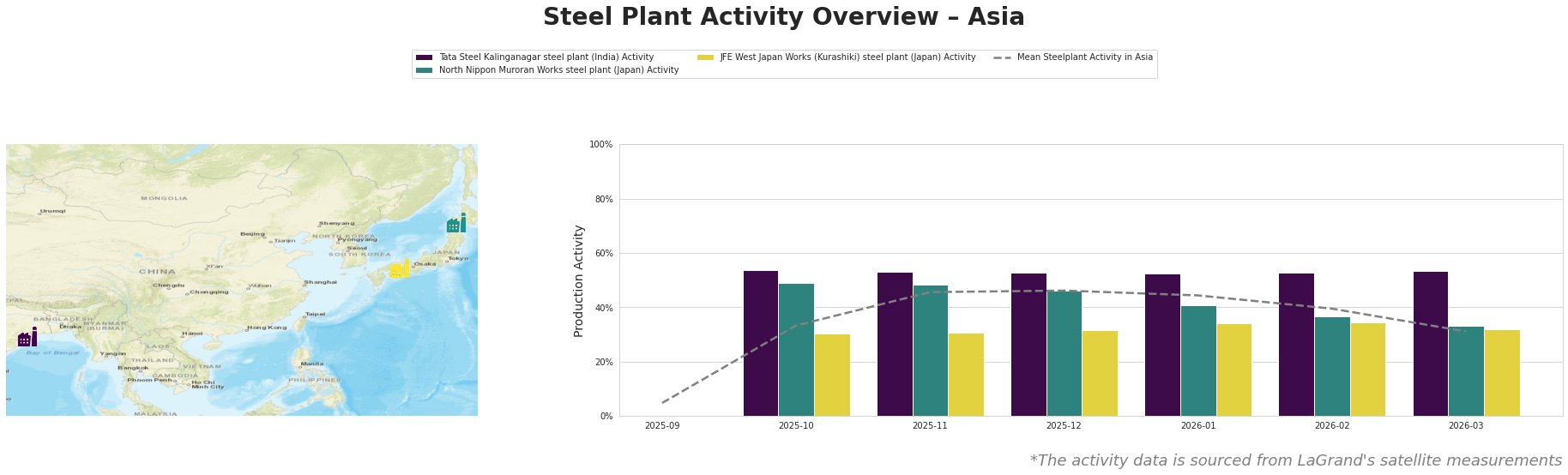
Tata Steel Kalinganagar, with reported activity remaining stable at 53.0%, continues robust operations, particularly in producing finished steel for the automotive sector. This stability may correlate with ongoing demands highlighted in automotive supply chain discussions, while no direct link can be firmly established between these concurrent developments and market activities.
North Nippon Muroran Works recorded a decline from 49.0% to 33.0%, suggesting some operational fluctuations. However, the current activity confirming at 33.0% is still projected to support automotive needs amid broader market pressures, as discussed in “Cosmin Bakai: European auto supply chain under pressure from China”. Despite these shifts, its strategic position supports resilience in production capabilities.
Conversely, JFE West Japan Works has shown slight downturns, dropping to 34.0% in March from October’s 30.0%. Aligned with the competitive narratives presented in recent discussions, this decline indicates adherence to market conditions. Nonetheless, the facility’s diversified production, including essential applications for building infrastructure, points to long-term viability despite short-term dips.
Given the backdrop of strategic industry challenges outlined in “CLEPA: EU automotive sector needs policies to strengthen competitiveness“, potential disruptions in supply chains warrant consideration. For stakeholders, particularly those involved in procurement, it is advisable to monitor Tata Steel Kalinganagar’s consistent output as a potential supplier of finished products, while also remaining cognizant of possible competitive pressures stemming from Japanese producers adjusting to new market conditions.
In conclusion, maintaining supplier relationships with Tata Steel and assessing the dynamics at North Nippon Muroran Works and JFE West Japan Works may provide steel buyers with valuable pathways to optimize their supply chain strategies in a positively shifting market.