


From the Field to the Dashboard – Built by Experts, for Experts.
Discover What's Really Happening in the Steel Industry
Use the AI-powered search engine to analyze production activity, market trends, and news faster than ever before.
Try the Free AI Search EnginePositive Momentum in Europe’s Steel Market: UK Government Measures Spark Activity
The European steel market exhibits a positive sentiment driven by recent developments in the UK, specifically the announced “Steel Strategy”, which aims to enhance domestic production. As indicated by the article, “UK announces new Steel Strategy, welcomed as game-changer by industry body,” the UK government plans to raise tariffs on excess imports and cut quotas significantly, shifting the landscape for steel buyers across Europe. Satellite data demonstrates an increase in activity at key plants, notably Emmenbrücke Swiss Steel and Voestalpine sites, reinforcing this trend.
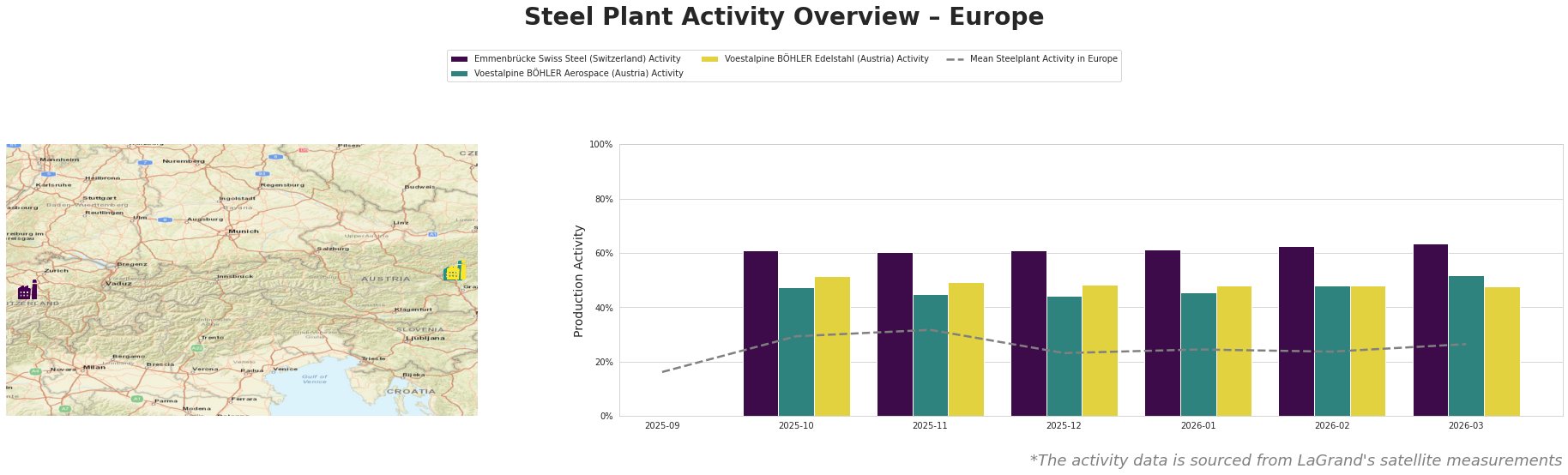
Emmenbrücke Swiss Steel’s activity has consistently increased, peaking at 64% in March 2026. This rise correlates positively with the increased tariffs and reduced quotas, as reported in “The UK is preparing to raise tariffs by up to 50% in the steel sector.” The consistent high activity levels suggest a resilient production strategy and adaptive market positioning in response to the changing regulatory environment.
Voestalpine BÖHLER Aerospace and Edelstahl displayed varied activity levels with the latter showing notable stability around 48-52% but a peak of 52% in March, likely supported by rising market prices and demand, as discussed in “Steel roll prices in the UK have risen sharply ahead of the announcement of the 50% tariff.” Conversely, BÖHLER Aerospace’s activity fluctuated between 45% and 47%, indicating a need for strategic agility in response to market pressures that the UK regulatory changes may exacerbate.
The potential for supply disruptions stemming from “UK traders fear closures from quota changes,” signals caution for buyers relying on UK imports. The announced 60% reduction in quotas could limit steel availability in the domestic market, thereby influencing buying strategies.
Steel buyers should consider expanding procurement from plants like Emmenbrücke, which are demonstrating strong performance and adaptability to market changes. Analysts are urged to monitor fluctuations in pricing tied to the government initiatives while exploring avenues to secure contracts with robust producers to mitigate risks associated with quota-related disruptions. Continuing engagement with suppliers will be essential to navigate the anticipated competitive landscape shaped by recent policy shifts.