


From the Field to the Dashboard – Built by Experts, for Experts.
Discover What's Really Happening in the Steel Industry
Use the AI-powered search engine to analyze production activity, market trends, and news faster than ever before.
Try the Free AI Search EngineEuropean Steel Market Outlook: Neutral Sentiment Amid Declining Exports and Mixed Plant Activity
EU steel exports are expected to decline by 12% in 2025, as underscored by the findings in EUROFER: Steel exports from the EU will decrease by 12% in 2025, trade deficit will increase. This significant reduction coincides with a widening trade deficit, which has risen to approximately 2 million metric tons per month, as reported in EUROFER: EU’s steel exports down 12 percent in 2025, trade deficit widens. Furthermore, updates on production in the steel tube sector indicate a slow recovery tied primarily to construction, indicating limited demand from traditional sectors.
Measured Activity Overview
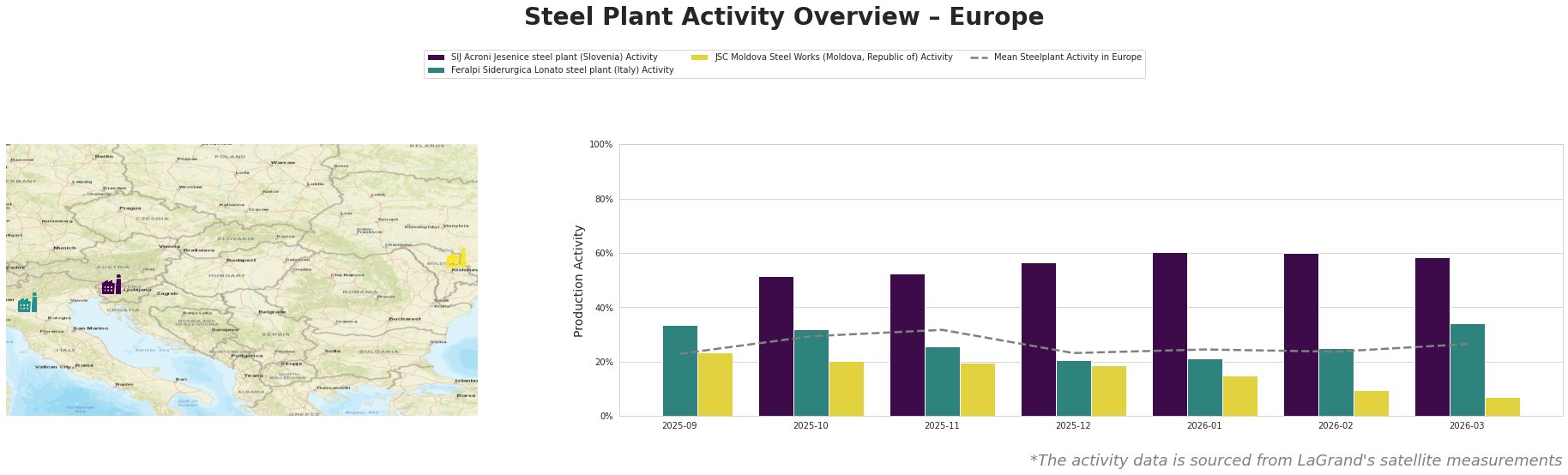
The mean activity level across steel plants in Europe demonstrates notable fluctuations. SIJ Acroni Jesenice has shown significant peaks, particularly reaching 60% in January and February 2026, likely indicating proactive production adjustments amid market shifts. In contrast, Feralpi Siderurgica Lonato has faced decreasing activity, dropping to 20% by December 2025, possibly reflecting weakened demand for finished products, in line with the observed drop in exports. The JSC Moldova Steel Works displayed an overall declining trend, with activity falling to just 10% in February, illustrating challenges in the export landscape.
Plant-Specific Insights
The SIJ Acroni Jesenice steel plant in Slovenia, with a crude steel capacity of 726,000 tons primarily via Electric Arc Furnace (EAF) technology, peaked at 60% activity in January and February 2026. This surge aligns with the heightened demand for finished products prior to the expansion of the trade deficit highlighted in EUROFER: EU’s steel exports down 12 percent in 2025, trade deficit widens. The subsequent drop to 58% in March suggests a reaction to diminishing export opportunities.
Feralpi Siderurgica Lonato in Italy, which specializes in rebar and billets, saw a substantial decline to 20% activity in December, rebounding slightly to 34% by March 2026. This suggests an adjustment to changing demand dynamics in the construction sector, linking back to the limited output recovery noted in the tube sector due to shifts in energy markets as mentioned in EU tube sector growth relying on construction: Eurofer.
For JSC Moldova Steel Works, which experienced a reduction in activity levels to just 7% by the end of March, this aligns with the reduced shipping capacity and increasing trade deficits in the region. The plant’s declining trend mirrors the overall negative sentiment in EU steel exports as evidenced in KEY reports.
Evaluated Market Implications
With a projected decrease in EU steel exports and widening trade deficits, steel buyers should remain cautious. Procurement strategies should prioritize securing specific types (such as finished products) from SIJ Acroni given its recovery activity trends, while cautioning against reliance on Feralpi and JSC Moldova due to recent activity declines. The imminent decrease in availability of flat rolled products and potential logistical disruptions may necessitate the timely acquisition of alternative suppliers, especially for construction in light of tube sector dependency on that market as per EU tube sector growth relying on construction: Eurofer. These actions, firmly anchored in the presented market data, will mitigate exposure to expected downturns in the export landscape.