


From the Field to the Dashboard – Built by Experts, for Experts.
Discover What's Really Happening in the Steel Industry
Use the AI-powered search engine to analyze production activity, market trends, and news faster than ever before.
Try the Free AI Search EnginePositive Trends in Asia’s Steel Market Amidst US Tariff Implications
Recent developments in Asia’s steel sector show a positive market sentiment as activity levels across significant plants demonstrate resilience. This uptick aligns with news surrounding US tariffs designed to bolster domestic steel production. Notably, the article New 25% Steel and Aluminum Tariffs Take Effect March 12 in US Boosting Domestic Producers highlights the potential for increased imports in Asia, as US tariffs, attributed to excess capacity concerns, lead to shifts in purchasing dynamics.
Measured Activity Overview
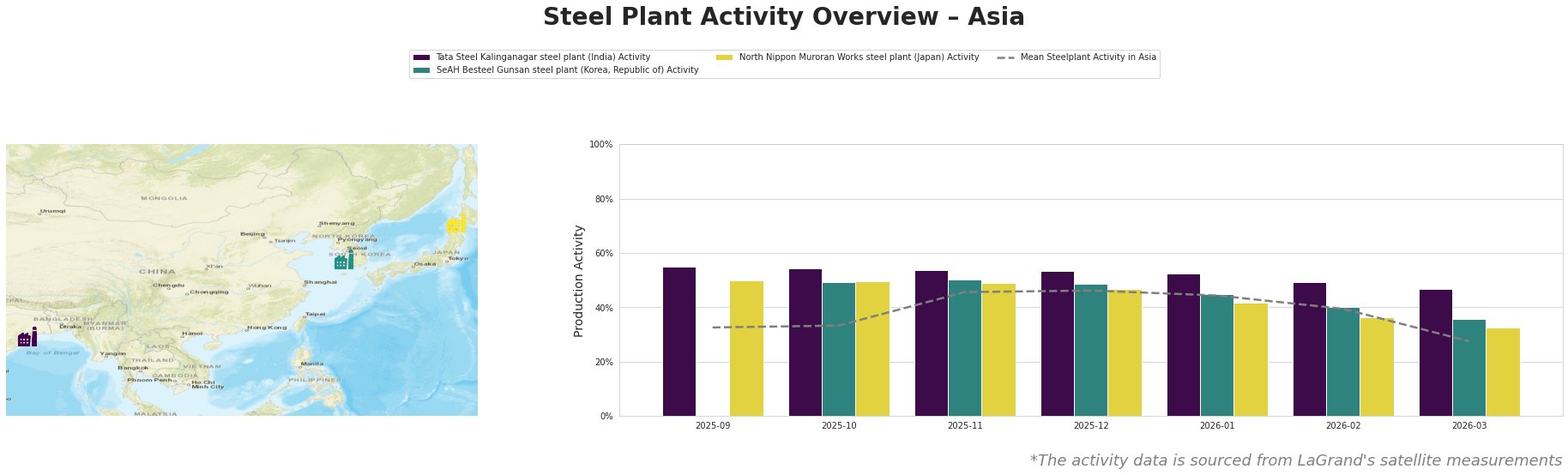
The mean activity level across Asian steel plants decreased significantly from December 2025 (46.0%) to March 2026 (28.0%), indicating a downward trend. However, Tata Steel Kalinganagar maintained higher activity levels consistently, peaking at 55.0% in September 2025. This consistent performance could reflect its solid production processes and market adaptation, while other plants like SeAH Besteel and North Nippon have shown more volatility.
Tata Steel Kalinganagar
Situated in Odisha, Tata Steel’s Kalinganagar plant utilizes the integrated blast furnace (BF) process with a capacity of 3,000 tonnes of crude steel. Its activity peaked at 55.0% in September 2025. Despite a slight decline to 47.0% in March 2026, this stability is notable. This ongoing productivity reflects potential shifts in demand due to the New 25% Steel and Aluminum Tariffs Take Effect March 12 in US Boosting Domestic Producers article’s implications on global steel trade, which could lead to regional supply advantages.
SeAH Besteel Gunsan
The SeAH Besteel Gunsan plant in South Korea primarily operates via electric arc furnaces (EAF) with a productive capacity of 2,100 tonnes. Its activity saw a high of 50.0% in November 2025 but fell to 36.0% by March 2026. The drop aligns with broader market activity trends and does not have a direct connection to the highlighted US tariff situations, which may impact its operational resilience by reshaping trade dynamics significantly.
North Nippon Muroran Works
With a capacity of 2,598 tonnes located in Hokkaidō, this plant consistently operates using blast furnace and basic oxygen furnace technologies. Activity levels declined from 50.0% in September 2025 to 33.0% in March 2026, mirroring the overall drop in mean activity across Asia. This decline aligns with potential tariff-induced shifts that could distort current market operations, particularly following the US Trade Representative launches investigations into 16 trading partners to combat excess steel capacity.
Evaluated Market Implications
The shift in activity levels, particularly at Tata Steel, highlights a robust strategic position against potential supply disruptions. Steel procurement professionals should consider sourcing from Tata’s Kalinganagar, where stable output contrasts with the volatility evident in the broader region observed in SeAH and North Nippon plants.
Given the increased US tariffs, expect competitive pricing adjustments from Asian producers, motivated by a reassessment of their export strategies. It is advisable for steel buyers to lock in contracts early to mitigate risks tied to fluctuating prices and further potential disruptions in imports from highly affected markets.
In conclusion, while current activity levels reflect some declines across the sector, specific plants like Tata Steel are positioned well to capitalize on the unfolding changes, presenting actionable procurement recommendations.