


From the Field to the Dashboard – Built by Experts, for Experts.
Discover What's Really Happening in the Steel Industry
Use the AI-powered search engine to analyze production activity, market trends, and news faster than ever before.
Try the Free AI Search EngineBrazilian Steel Market Faces Downturn Amid Rising Fuel Costs and Tax Changes
Brazil’s steel sector is experiencing a negative shift, heavily influenced by fuel price volatility linked to the ongoing US-Iran conflict. Notable changes in market activity can be attributed to Petrobras halts marine fuel indications in Brazil and Brazil scraps tax on diesel amid Iran war, reflecting on steel plant operations. Recent satellite data reveals a marked decline in steel production—evident across multiple plants—suggesting a potential disruption in supply chains.
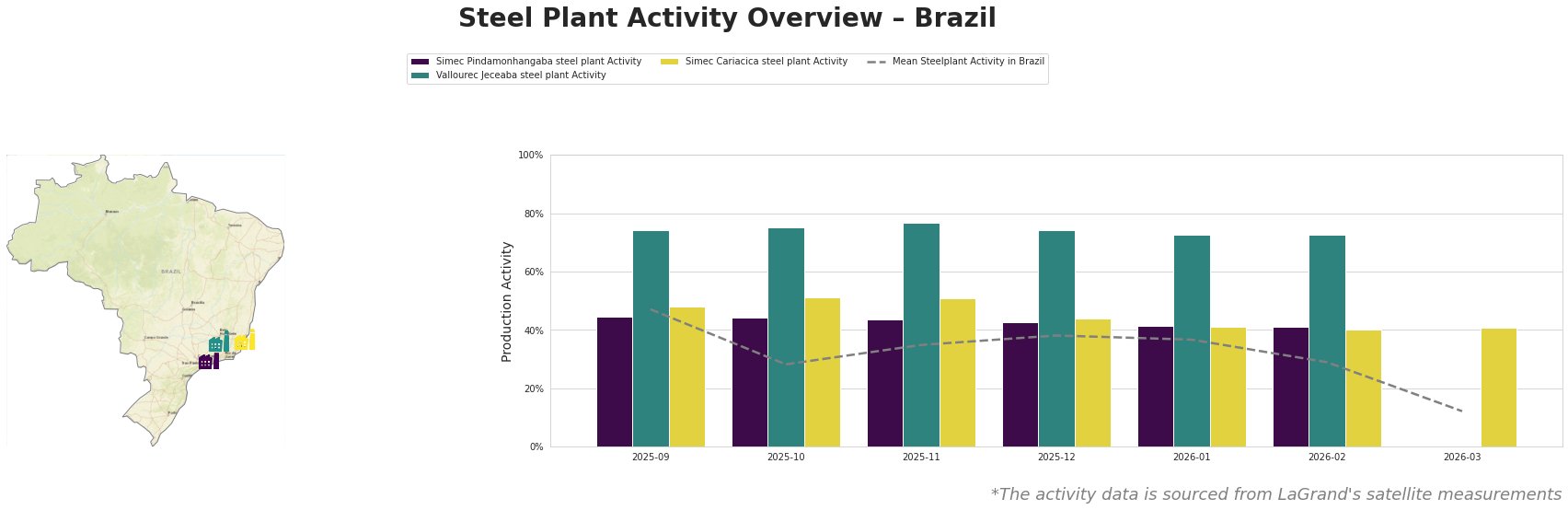
Across January to March 2026, activity levels at Brazil’s steel plants dropped sharply, with a significant decline noted in March, where the mean activity plummeted to 12%. The Simec Pindamonhangaba plant exhibited stability until this drop but maintained a comparatively low production level at 41% in February. The Vallourec Jeceaba plant showed a strong performance peaking at 77% in November but did not report activity data in March, indicating possible operational suspensions. In contrast, Simec Cariacica remained functional at 41% in March but could not offset the overall industry decline.
Simec Pindamonhangaba, primarily producing finished rolled products like wire rod and rebar using EAF technology, posed a critical point of observation. The inactivity reported in March aligns with disruptions noted in Petrobras halts marine fuel indications in Brazil, highlighting a potential interconnection where halted fuel quotes affect production capabilities. Vallourec Jeceaba, focused on energy sector products, found itself unable to sustain levels amidst rising input costs due to high diesel prices linked to geopolitical tensions. In parallel, Simec Cariacica’s output, although still operational, signals hints of restricted production capacities due to overall negative market sentiments.
Steel buyers should be acutely aware of the current environment’s repercussions, primarily revolving around fuel cost increases directly impacting steel production. As the Brazilian government introduces measures like the tax elimination on diesel aimed at reducing consumer costs, the immediate effects on the steel supply chain remain uncertain, and potential procurement disruptions are likely. Buyers may want to consider securing orders in advance to mitigate risks stemming from anticipated supply interruptions, particularly from the Vallourec Jeceaba plant, given its previous production volatility amid rising geopolitical tensions and fluctuating fuel costs.