


From the Field to the Dashboard – Built by Experts, for Experts.
Discover What's Really Happening in the Steel Industry
Use the AI-powered search engine to analyze production activity, market trends, and news faster than ever before.
Try the Free AI Search EnginePositive Outlook for Asia’s Steel Market Amid Regional Energy Initiatives
Recent developments in Asia’s steel market are set against a backdrop of increasing plant activity and strategic energy policy discussions. Notably, the articles “The EU seeks to ease pressure on industry due to energy prices“ and “EU examines short-term measures to reduce industrial energy costs“ underscore a proactive effort to mitigate high energy expenses that threaten competitiveness. While these articles focus on the EU, they highlight an overarching context affecting energy costs globally, indirectly supporting the positive sentiment around Asia’s steel plants.
Measured Activity Overview
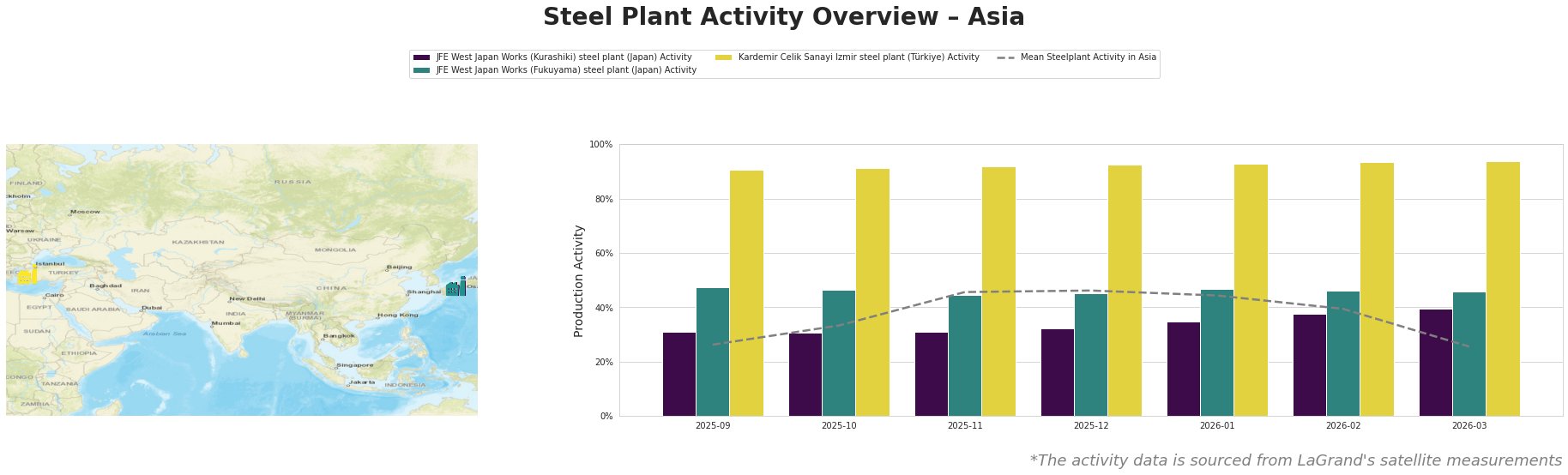
The satellite data indicates that steel plant activity across Asia experienced fluctuations, with mean activity peaking at 46% in November and December 2025, reflecting positive operational trends before a drop to 26% by March 2026. The Kardemir Celik Sanayi Izmir steel plant exhibited remarkable stability, maintaining a high activity level around 94%, suggesting strong demand and operational efficiency. Both JFE plants (Kurashiki and Fukuyama) saw less consistent activity, with Kurashiki reporting notable variance, directly experiencing a decrease in operational levels aligning with market pressures discussed in the cited news articles; however, no direct link to activity was specified.
Evaluated Market Implications
With energy price discussions poised to influence industrial competitiveness, attention should be directed towards the Kardemir Celik Sanayi Izmir steel plant, which currently stands strong in operational capacity. Procurement actions for steel should prioritize sourcing from this plant due to its consistent activity levels, which may stabilize pricing in periods of uncertainty linked to geopolitical energy fluctuations.
Conversely, fluctuations in activity at JFE’s plants highlight potential supply disruptions, especially given their variability and the current mean activity dropping rapidly by March 2026. Buyers and analysts should prepare for possible delays or shortages from these regions, emphasizing the need for diversified sourcing strategies that consider both stable suppliers like Kardemir and the more volatile JFE operations.
As energy discussions evolve, monitoring the impact of EU actions on global energy pricing will be crucial for forecasting market conditions, thus allowing informed decisions on procurement timelines and strategies in the upcoming quarters.