


From the Field to the Dashboard – Built by Experts, for Experts.
Discover What's Really Happening in the Steel Industry
Use the AI-powered search engine to analyze production activity, market trends, and news faster than ever before.
Try the Free AI Search EngineSteel Market Outlook for Asia: Demand Declines amidst Geopolitical Tensions
Asia’s steel market sentiment has turned negative in March 2026, driven by significant activity reductions in major plants and geopolitical instability impacting supply routes. According to the news article “Iran war collapses visibility in European jet market,” volatility in the European jet fuel market is affecting global steel dynamics. The escalating crisis has contributed to instability in shipping and raw material supply, compounded by “US Gulf coast jet fuel prices at 44-month high,” which emphasizes the interconnectedness of energy prices and steel production costs. Satellite measures indicate sizeable drops in plant activity, highlighting the severity of the situation.
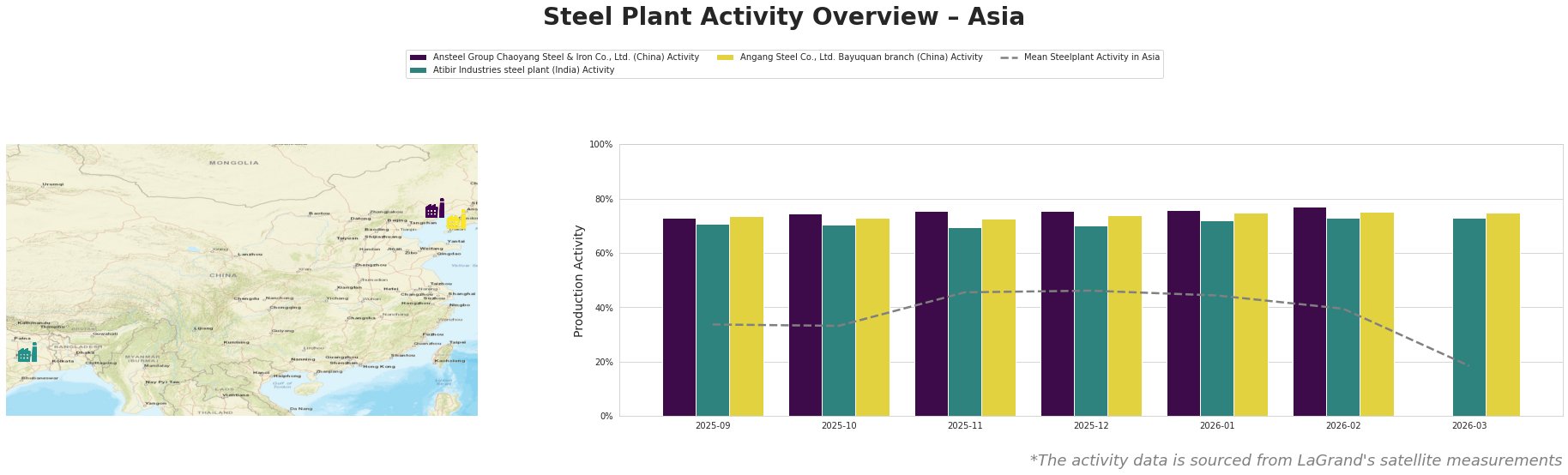
The mean activity level across Asia’s steel plants dropped dramatically to 18.0% by March 31, 2026, with Ansteel Group Chaoyang Steel & Iron Co., Ltd. reporting a peak activity of 77.0% just a month prior but marking an abrupt halt in March, indicating a potential shutdown. The “European jet values triple from all-time highs“ suggests suppliers may be pulling capacity to recalibrate to unprecedented energy costs, mirroring Ansteel’s drop.
Atibir Industries, with a sustained activity of 73.0% in March, has remained stable despite these conditions; however, its lack of upward movement may signal market hesitance amidst rising costs driven by broader geopolitical factors impacting supply chains.
Angang Steel Co., Ltd. Bayuquan branch maintained a steady output of 75.0% during March, yet faces the risk of disrupted operations linked to a volatile market, as highlighted by rising energy costs from “European MR freight rates soar on US-Iran.”
Current dynamics suggest that steel buyers should consider:
- Strategic Stockpiling: With significant uncertainty in supply lines due to the geopolitical crisis and related energy spikes, buyers might want to increase inventory for critical applications, particularly raw materials and semi-finished products, to mitigate future disruptions.
- Diversifying Suppliers: Engaging with reliable alternative suppliers can buffer against sudden hikes in supply costs or availability, particularly suppliers outside the conflict-impacted regions.
The current market conditions justify a cautious approach to procurement, with a focus on contingency planning amidst ongoing volatility in both steel and associated energy markets.