

From the Field to the Dashboard – Built by Experts, for Experts.
Discover What's Really Happening in the Steel Industry
Use the AI-powered search engine to analyze production activity, market trends, and news faster than ever before.
Try the Free AI Search EngineEuropean Steel Market Thrives as France Unveils €1.1 Billion Clean Technology Investment
Recent developments in the European steel market indicate a very positive sentiment, largely influenced by France’s approval of “The EC has approved France’s €1.1 billion scheme to support investment in clean technologies.” This investment is anticipated to drive growth and enhance production capabilities across the region, correlating with increased activity levels at key steel plants, although specifics on individual plant impacts remain complex.
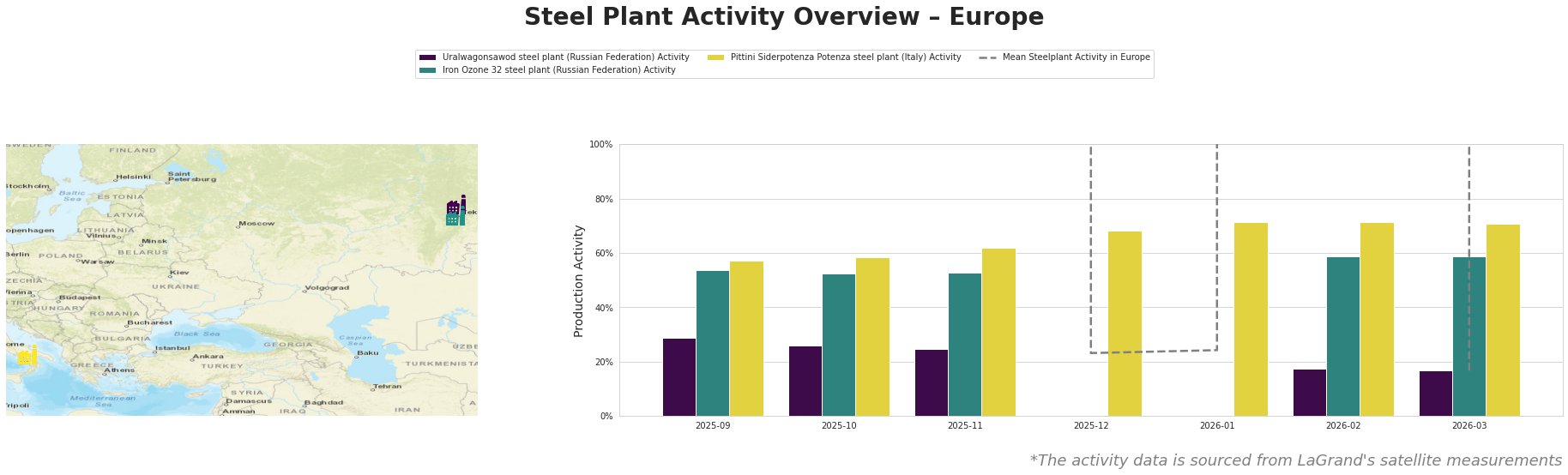
Activity levels have notably declined since 2025, with February 2026 witnessing a drastic fall in mean activity to 16% from earlier peaks while Pittini Siderpotenza maintains an impressive 72% despite fluctuating trends in others, suggesting resilience amidst overall downward shifts. This stability connects indirectly to the optimism surrounding France’s clean energy investments. Uralwagonsawod and Iron Ozone 32 exhibit lower activity, remaining below the European average, with Uralwagonsawod’s activity falling to 17% in both February and March 2026.
Uralwagonsawod steel plant operates without internationally recognized quality certifications and has faced significant drops to 17% in recent months; however, no direct connections to recent news developments can be substantiated. The Iron Ozone 32 steel plant, utilizing Electric Arc Furnace (EAF) technology, maintains a more stable operation with 59% activity in recent measurements. While no direct links exist between this plant’s stability and French clean tech investments, the overall industry sentiment may bolster future activity.
Pittini Siderpotenza Potenza, focused on rebar production for construction, remains robust at 71% as of March 2026. The plant’s resilience may reflect benefiting indirectly from the heightened focus on clean technology and infrastructure outlined in the approved aid, creating potential supply equity in light of fluctuating activity elsewhere.
Market implications suggest potential supply disruptions, particularly from the Uralwagonsawod plant. Buyers should prepare for uncertainty in sourcing from this facility. To mitigate risks, proactive procurement strategies focusing on stronger-performing plants like Pittini Siderpotenza, which is well-positioned with a sustained output, are recommended. Buyers should engage with Pittini for long-term contracts to ensure stability. Monitoring developments related to the French investment scheme could yield opportunities for collaboration or sourcing from manufacturers aligning with the clean technology push.