


From the Field to the Dashboard – Built by Experts, for Experts.
Discover What's Really Happening in the Steel Industry
Use the AI-powered search engine to analyze production activity, market trends, and news faster than ever before.
Try the Free AI Search EngineSteel Market in Asia Faces Pressure: Activity Declines Amid Production Cuts
In Asia, the steel market is increasingly strained as demonstrated by the insights from Global steel production fell by 6.5% y/y in January and World crude steel output down 6.5 percent in January 2026. These reports highlight significant reductions in production levels, particularly in China, which has cut output by 13.9%, leading to a palpable decrease in activity at major steel plants across the region.
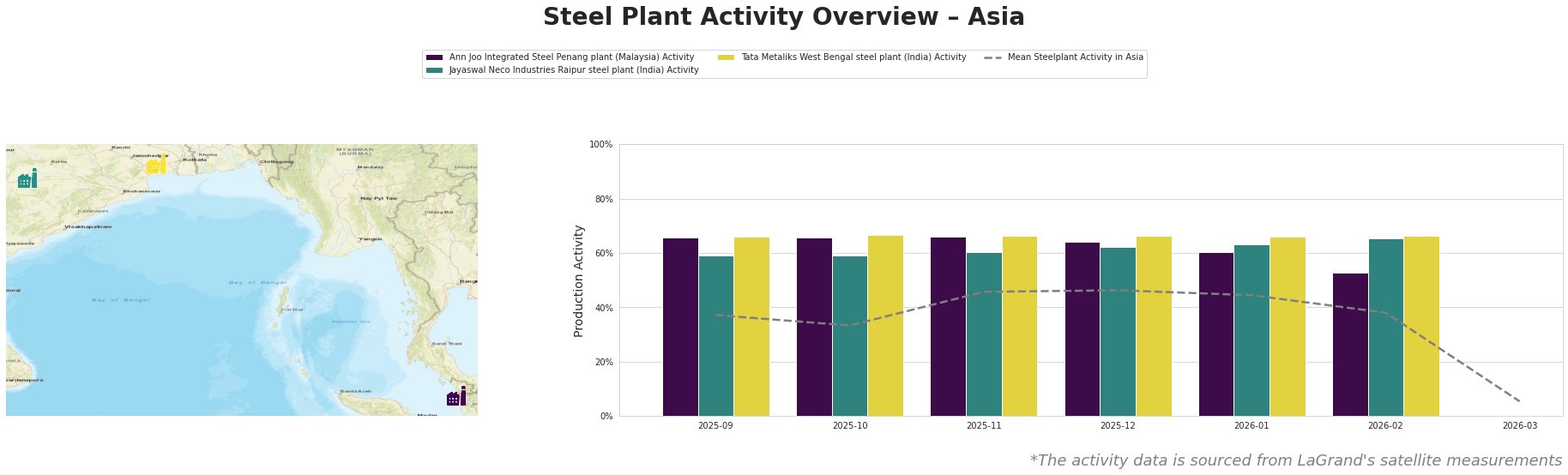
Over the monitored period, the mean activity of steel plants in Asia has significantly fluctuated, dropping to 5% in March 2026 from stable levels around 44-46% in late 2025. The Ann Joo Integrated Steel Penang plant has seen a notable decline, with activity falling from 66% to 53% in February 2026, aligning with the broader production downturn reported in World crude steel output down 6.5 percent in January 2026. The Jayaswal Neco Industries Raipur steel plant, however, experienced resilience, with an increase in activity from 63% to 65% during the same period, indicating possible operational adjustments or a focus on specific outputs amidst general market declines.
In contrast, Tata Metaliks West Bengal steel plant consistently maintained a stabilizing activity level at 66%, despite the overall downward trend, though future activities may be affected by sector-wide supply chain disruptions.
Potential supply disruptions are apparent, especially for plants like Ann Joo and Jayaswal Neco, which are closely tied to the declining output trends in China. Steel procurement professionals should consider the reduced output from Global pig iron production fell by 6% y/y in January, further tightening material availability.
To mitigate risks, buyers should prioritize sourcing from plants with stable activities, such as Tata Metaliks, while closely monitoring market conditions and potential changes in production levels prompted by ongoing geopolitical and economic factors. Diversifying supply chains and increasing stock levels could be prudent given the negative sentiment prevailing in the Asian steel market.