


From the Field to the Dashboard – Built by Experts, for Experts.
Discover What's Really Happening in the Steel Industry
Use the AI-powered search engine to analyze production activity, market trends, and news faster than ever before.
Try the Free AI Search EngineEuropean Steel Market Thrives: Italy’s Production Surges Amid Strong Sentiment
In Europe, January 2026 has marked a significant boost in steel production, particularly in Italy, where output climbed by 19.2% m/m as highlighted in the news article Italy increased steel production by 19.2% m/m in January. This increase aligns with satellite observations showing heightened activity at major steel plants, particularly in response to recovering global demand, contrasting with an overall decline in EU production for 2025 as outlined in the article Italian crude steel production up 1.6 percent in January 2026.
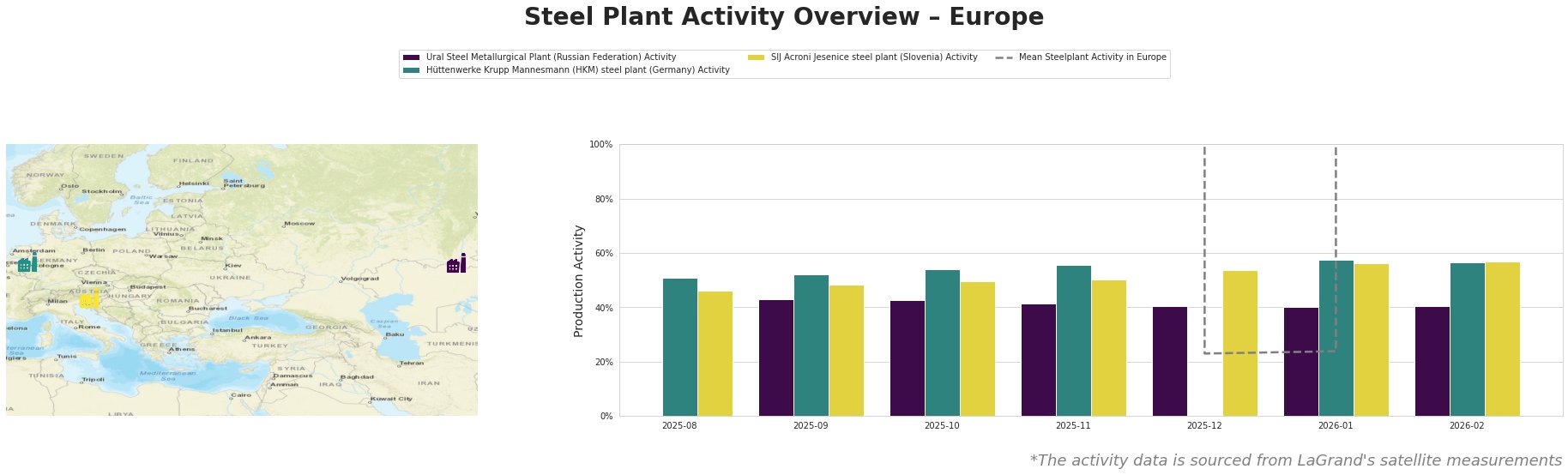
Ural Steel Metallurgical Plant showed stable activity around 40% in January, markedly lower than the peak in October (43%), indicating a well-maintained output yet underperformance in the broader market context. While this plant’s activity does not directly correlate with the positive trends seen in Italy, the events surrounding Metinvest’s finished product output increased by 13% due to European assets indicate a restoration of flat product capabilities in response to demand, potentially affecting Ural’s imported supply or competitiveness.
HKM in Germany presented a notable rise to 58% activity in January, up from 56% in the previous month, reflecting a robust engagement likely influenced by regional demand. This steady peak was consistent with the sentiment from Italian crude steel production up 1.6 percent in January 2026, where neighboring production trends have rippled benefits through the supply chain.
Conversely, SIJ Acroni maintained around 56% in both January and February, indicative of their stable output of finished rolled products. However, no explicit connections can be drawn with the recent surge in Italy, showing potential supply stability amid broader market shifts.
The evaluated data reveals potential supply risks, particularly in countries with less increasing activity compared to Italy. Buyers should prioritize sourcing from producers showing robust growth, such as those involved in the Italian supply chain that can capitalize on increased demand and operational enhancements signaled by the latest news.
Actionable Recommendations for Steel Buyers:
– Short-term Procurement: Focus on increasing orders from Italian plants and subsidized European production sources to mitigate potential supply disruptions caused by fluctuations in production outputs observed in Russia and Slovenia.
– Long-term Collaboration: Forge partnerships with HKM and other high-activity plants to ensure preference in allocation during peak demand seasons.
– Monitor Markets Regularly: Keep abreast of satellite activity observations and regional production dynamics to anticipate supply changes and align procurement strategies accordingly.