


From the Field to the Dashboard – Built by Experts, for Experts.
Discover What's Really Happening in the Steel Industry
Use the AI-powered search engine to analyze production activity, market trends, and news faster than ever before.
Try the Free AI Search EnginePositive Uptrend in European Steel Market: Insights from Ukraine’s Export Dynamics and Plant Activity
In Europe, the steel market is currently experiencing a positive sentiment driven by significant developments in Ukraine. Notably, “Ukraine’s total steel exports up 8.1 percent in Jan 2026“ and “Flat steel exports from Ukraine fell by 12.4% m/m in January“ indicate evolving dynamics in production and export patterns, directly correlated with changes in satellite-observed activity levels at key steel plants.
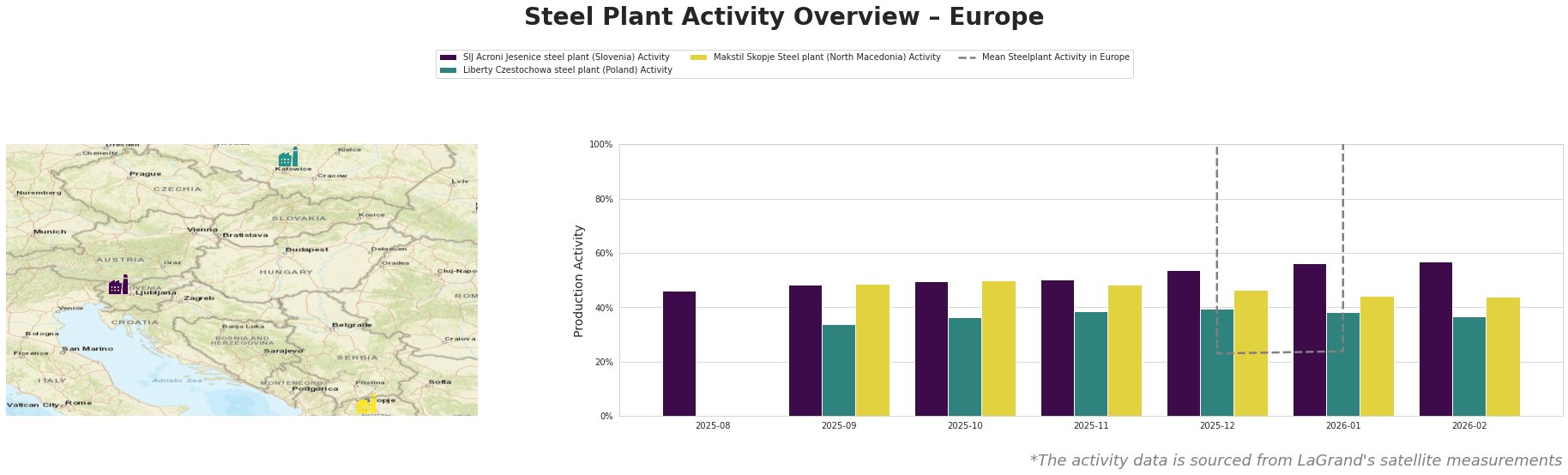
The activity at the SIJ Acroni Jesenice steel plant has increased from 54% to 57% in June 2026, aligning with overall improving market conditions despite decreased flat steel exports as noted in “Flat steel exports from Ukraine fell by 12.4% m/m in January.” This uptick indicates the plant’s responsiveness to ongoing demand, particularly in semi-finished and finished rolled products.
The Liberty Czestochowa steel plant’s activity remains relatively stable but shows a consistent capacity utilization near 38-40%. This steadiness may help mitigate supply disruptions, as increasing imports, particularly of semi-finished products, are vital for upcoming production cycles (supported by “Ukraine imported 65.3 thousand tons of flat rolled steel in January“).
Meanwhile, the Makstil Skopje steel plant has maintained an activity level fluctuating around 44-50%, which aligns with the reduced exports from Ukraine of long steel as highlighted in “Ukraine reduced its exports of long rolled steel by 62% y/y in January.” While this could translate to potential supply constraints for products traditionally sourced from Ukraine, the plant’s continual operation provides a reliable alternative for regional buyers.
Evaluated Market Implications
Given the current trends:
- Potential Supply Disruptions: The significant drop in Ukraine’s long steel exports poses risks, primarily affecting EU buyers dependent on this segment, notably in construction sectors.
- Recommended Procurement Actions: Steel buyers should prioritize engagements with plants like SIJ Acroni and Makstil, capable of fulfilling both finished and semi-finished product demands. Given their positive operational trends in January and February 2026, initiating long-term contracts could be strategic to shield against volatility arising from declining Ukrainian exports.
This observed resilience combined with positive supply chain responses underscores a robust opportunity for informed buying strategies in the European steel market.