


From the Field to the Dashboard – Built by Experts, for Experts.
Discover What's Really Happening in the Steel Industry
Use the AI-powered search engine to analyze production activity, market trends, and news faster than ever before.
Try the Free AI Search EngineSurge in Asian Steel Activity Amid Positive Market Sentiment: Key Insights for Buyers
Recent developments in the Asia steel market have led to a very positive outlook, driven by a notable increase in plant activity levels. The recent news article titled US high court strikes down Trump’s tariffs: Update demonstrates a shift in tariff implications, which has indirectly contributed to increased operational confidence among Asian steel manufacturers. Additionally, satellite observations reveal a marked uptick in activity levels at key steel facilities.
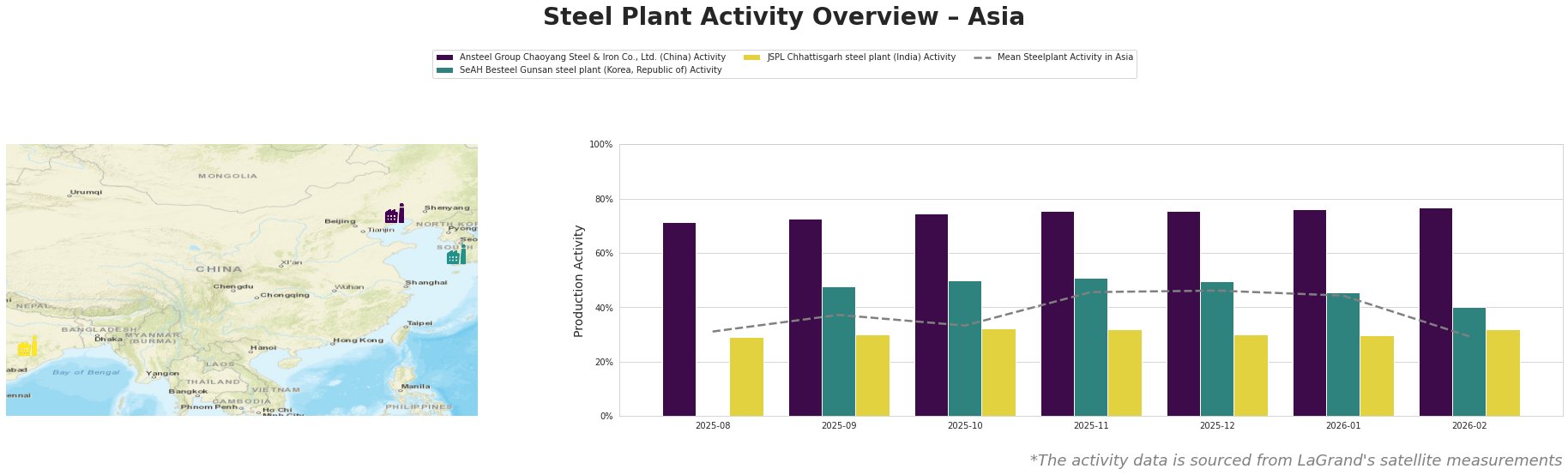
Ansteel Group Chaoyang Steel & Iron Co., Ltd. in Liaoning has maintained high activity levels, peaking at 77% in February 2026—a significant rise from 71% in August 2025. This steady performance aligns well with the broader sentiment following the Supreme Court ruling, fostering an environment conducive to increased production.
In contrast, the SeAH Besteel Gunsan steel plant experienced fluctuations, from 48% in September 2025 to 40% in February 2026, indicating uncertainty that may be linked to tariff changes, notably New Trump tariffs to exempt energy, metals, USMCA, which brought forth pending adjustments in market dynamics for specific steel categories.
JSPL Chhattisgarh witnessed consistent lower activity levels, remaining around 30% to 32%, showing less volatility compared to its counterparts. The immediate facility status remains unaffected by the recent news—no direct correlation to the tariff changes could be established, indicating steady operational conditions amidst external market pressures.
Given the evidence of improving activity levels, suppliers and buyers in Asia should consider strategic procurement actions. Specifically:
- With Ansteel’s escalating output, consider approaching them for bulk transactions to secure favorable pricing before potential market corrections arise.
- Monitor SeAH Besteel to gauge how tariff exemptions affect their pricing strategy for special steels and heavy forged products as market conditions evolve.
- For JSPL, while currently stable, buyers may want to evaluate longer-term contracts as a hedge against future supply uncertainties linked with fluctuating regulations in the steel sector.
As the steel production landscape adapts to new tariff policies, vigilant monitoring and strategic procurement will be crucial for optimizing supply chains and managing costs in this dynamic market.