


From the Field to the Dashboard – Built by Experts, for Experts.
Discover What's Really Happening in the Steel Industry
Use the AI-powered search engine to analyze production activity, market trends, and news faster than ever before.
Try the Free AI Search EngineNorth America’s Steel Market Faces Decline Amid Political Uncertainty
Recent developments in North America’s steel market indicate a negative sentiment, primarily driven by shifting political dynamics and observed declines in plant activity. The articles ‘Doubling down on stupid’: Newsom, AOC, trash Trump at European summit as they raise 2028 profiles and Sicherheitskonferenz: ++ „Trump wird in drei Jahren weg sein“ – Newsom ruft Europäer zu Widerstand gegen US-Präsident auf ++ Liveticker highlight U.S. political tensions that may influence market conditions. As political leaders criticize past policies, satellite data reveals significant decreases in steel plant activities, underscoring a tangible impact on production.
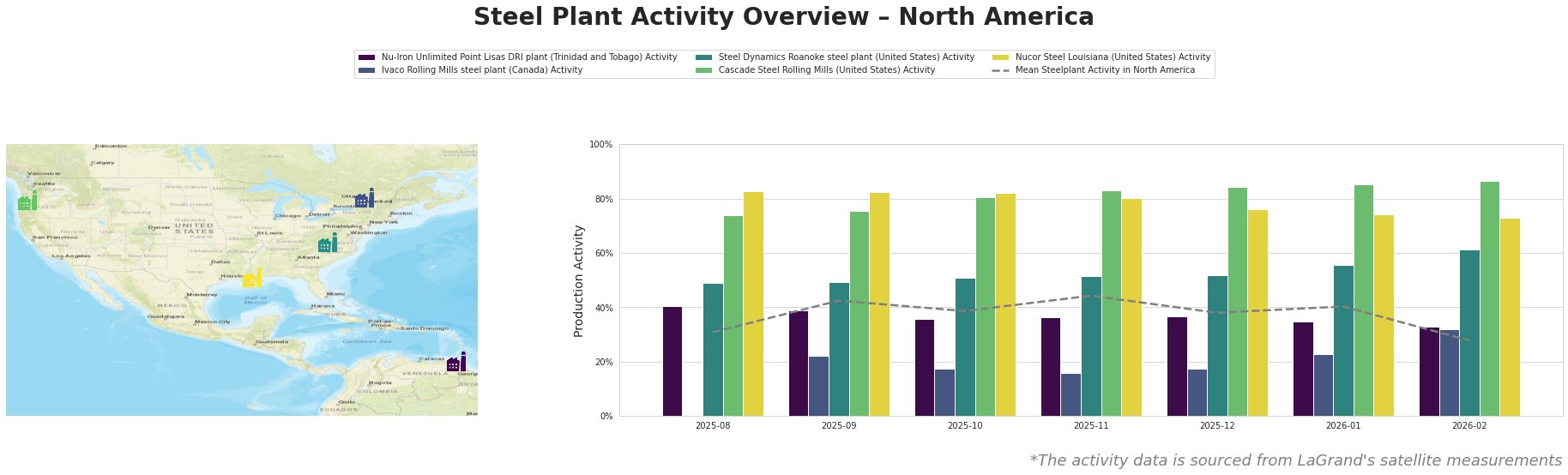
Among the evaluated steel plants, activity has notably fluctuated. The Ivaco Rolling Mills in Ontario faced a steep decline, reaching just 16% activity in November 2025 and only recovering slightly to 23% in January 2026. This correlates with the broader negative trend as political rhetoric suggests an uncertain future for industry leadership.
Steel Dynamics Roanoke’s activity level, stable at 51% for several months, peaked at 61% in February 2026 but is now trending downward, reflecting a potentially temporary increase and creating vulnerability in ongoing procurement strategies.
Cascade Steel Rolling Mills has, however, demonstrated resilience, with an activity peak of 87% in February 2026—a sign of strong operational health, possibly insulated from the political reverberations highlighted in the news articles. Nu-Iron’s activity followed a decreasing arc, dropping from 41% down to 33% as of February 2026.
The evaluated market implications show potential supply disruptions at Ivaco Rolling Mills and Nu-Iron Unlimited, necessitating immediate re-evaluation of procurement strategies for steel buyers. Buyers should consider hedging against supply inconsistencies from these plants. Given Cascade Steel’s robust performance, stakeholders might benefit from increasing reliance on this producer to mitigate risks related to political instability and fluctuating production efficiencies elsewhere.
In summary, as political contexts evolve, the fluctuations in plant activity signal a pressing need for proactive procurement strategies tailored to ensure supply chain stability amidst an uncertain market.