


From the Field to the Dashboard – Built by Experts, for Experts.
Discover What's Really Happening in the Steel Industry
Use the AI-powered search engine to analyze production activity, market trends, and news faster than ever before.
Try the Free AI Search EngineTurbulent Times for China’s Steel Market Amidst Rising Trade Barriers
China’s steel industry faces significant challenges as evidenced by recent developments and declining plant activity levels. With the introduction of anti-dumping duties by Turkey, specifically noted in the articles “Türkiye imposed anti-dumping measures on cold-rolled stainless steel imports from China“ and “Turkey issues AD duty on CR stainless flat steel imports from China,” steel exporters may confront obstacles to market access, potentially impacting demand for Chinese steel products. Satellite data corroborates this trend, reflecting marked reductions in plant activity across key facilities in China.
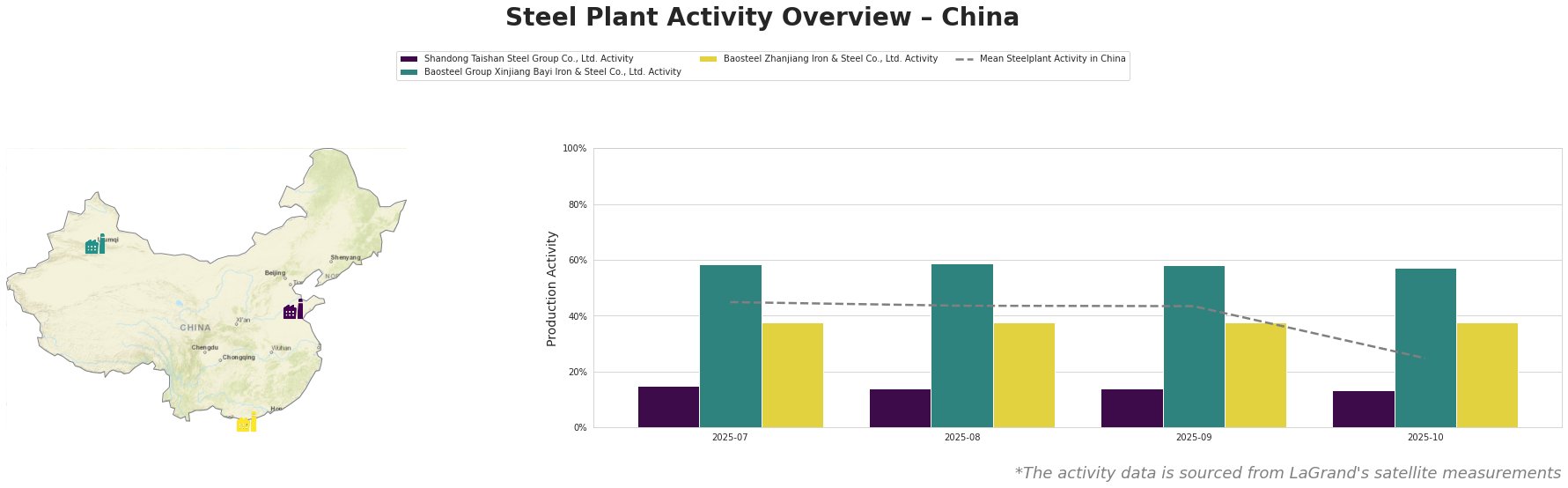
The mean steelplant activity across China has dropped sharply from 45% in July 2025 to 25% in October 2025. Notably, Shandong Taishan Steel Group Co., Ltd. reported a drop from 15% to 13% during the same timeframe, which could indicate a direct correlation to the heightened tax burden from Turkey’s anti-dumping measures. Despite its higher operational capacity compared to others, this drop likely results from reduced export opportunities linked to international trade tensions.
Baosteel Group Xinjiang Bayi Iron & Steel Co., Ltd. and Baosteel Zhanjiang Iron & Steel Co., Ltd. exhibited relative stability in activity levels around 58%-59%, but both are still well below their capacity potential and constrained by market conditions. The inability to react quickly to changing trade dynamics, exemplified by the drop in the overall activity levels since Turkey’s duties may provoke a contraction in production.
In light of these observations, steel buyers should approach procurement strategies with caution; specifically, now may be an opportune time to renegotiate supply terms with existing suppliers, considering the potential supply disruptions stemming from Turkish tariffs, which could disrupt the stability of current pricing structures. Additionally, diversifying sources or exploring alternative raw materials may mitigate risks associated with decreased production capacity amid continuing geopolitical obstacles.